Olá! Could you imagine your life with a distaff and a spindle always at your side? If you were a woman born in Portugal 150 years ago you would know what I mean… At that time spinning was the most popular and common occupation for women.
The use of flax as a textile fiber is lost in time… Spun, dyed, and knotted wild flax fibers were found dating 30,000 BC. And the Pharaohs used linen cloth, found in their tombs. In the territory which is now Portugal, the cultivation of flax and its use in textiles also dates from prehistoric times. In different places, capsules of flax seed and a small scrap of linen have been found dating back to 2500 BC and 2000 BC.
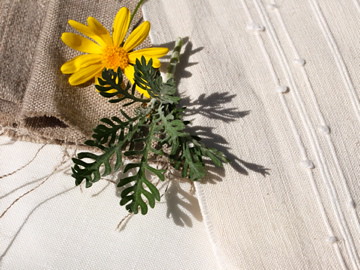 |
| Portuguese Linen - white, estopa (tow) and handmade linen |
Flax culture and linen production are a part of Portuguese history… From 1014 in Guimarães, many people were directly or indirectly involved in linen production. Linen from this region was well known for its excellence - from the farmers to those that prepared the fibers, to those who were responsible for the spinning and weaving.
But flax culture was spreading all over the country. From the poorest to the richest family, all grew flax. And women did domestic spinning, too, which was associated with other domestic activities. Weaving was usually done outside the home, which implied some professional specialization.
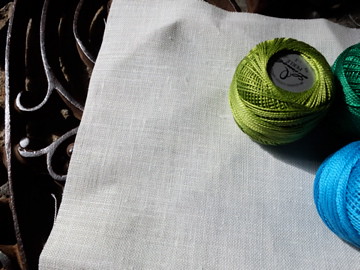 |
| White linen from Guimarães |
"From the North to the South of Portugal, there was no farmer who did not cultivate the flax, no woman who did not spin and no village (from the poorest to the richest) which did not have one or more looms."
From the 13
th century to 15
th century, linen, which was used as payment to lords and the church, was the prime industry in Portugal. Linen cloth was used intensively in daily life, in household linen, in clothes, in church… A local popular saying is very illustrative of linen's importance: “after gold is linen”!!
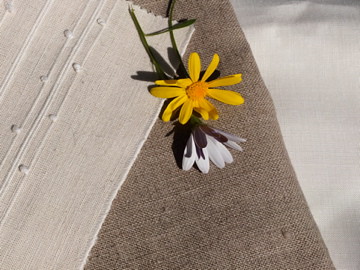 |
| Portuguese linen |
The importance of linen in Portuguese culture is stated by the fact that in Madeira Island, until the 19th century, the number of linen fabrics determined the value of a bride's dowry. And most linen production was aimed at that end. Since it is a very complex and labor-intensive activity, there were times when a decline in flax culture occurred, as during the Portuguese Maritime Exploration, when many tried their luck overseas. The demand of the fibers did not totally diminish as linen was used not only in thread and fabrics, but also in
treu - used in cloth for boats’ sails – and rigging.
Some identify the decline in flax culture at this age. With the coincidence of the beginning of silkworm culture, followed by alternative uses of the soil, ending in 19th century with the “royal” preferences for cotton. The complexity of linen production that for so long had justified the overpopulation in the North region contributed to its decline once cheaper fabrics like cotton, became widespread. In many regions of the interior of the country, cotton use only occurred after the arrival of the train, which contributed to the price of cotton becoming unbeatable. After World War II, the Portuguese government tried to intensify linen production, but without success.
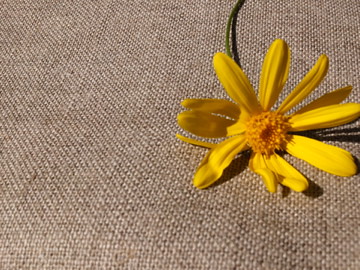 |
| Estopa (tow) from Guimarães |
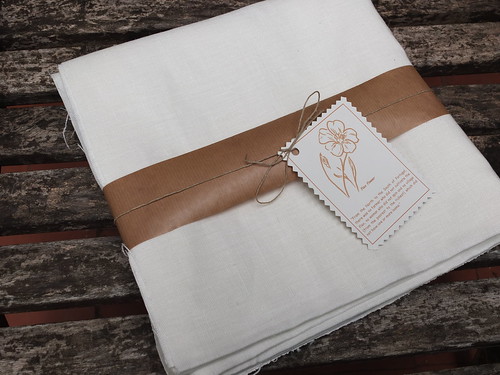
Nowadays there is localized industrial linen production and there are still population groups that manually produce linen, with some producers organized into cooperatives. However, most of these initiatives support local tourism rather than supplying the market with handmade fabrics. These photos show two different types of linen fabrics, produced by one of the most well-known and antique Portuguese linen manufacturers from Guimarães. The darker piece of fabric is my favorite linen cloth. We call it
estopa (tow), and it is made of the shorter flax fibers. It’s known for being of less quality, but that’s not important to me… I also have with me a small sample of handmade linen to share with you. This kind of work, weaving and pulling the thread, is very traditional in our country.
The entire cycle of linen production is incredibly beautiful… I wanted to describe it here… And I began doing that… But soon I understood that it would be foolish… Someone has already done it in such an incredible manner…
Alice did a great work…
Promise me you’ll read
this (and
this) description of the linen production cycle, written both in Portuguese and English and documented with marvelous photos.You’ll also find a beautiful description of
how to make a spindle… And do not forget to browse
these photos – You won't regret it!!
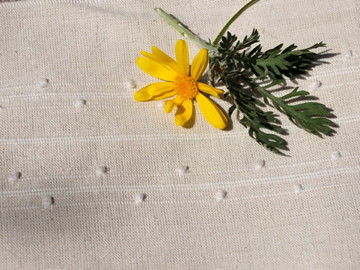 |
| Handmade Linen |
Flax is also used to produce twine and rope, linseed oil used in industry, nutritional supplements (always in my breakfast) and it is also grown as an ornamental plant in gardens. But... why am I talking about linen? Talking about Portuguese traditional embroidery and not talking about linen would not be possible. Almost all traditional Portuguese embroideries use linen and, usually, its replacement by cotton is only due to price. So the history of linen is the history Portuguese embroidery and, of course, the History of Portugal.
I believe that the inspiration that comes from linen exceeds the beauty of fabrics… That linen has also inspired popular poetry is very richly and well documented. The feeling of community that was present in the linen production cycle made people’s lives happier, creating rituals and legends that last until our days.
Linen's natural beauty can be an incredible source of inspiration as stated in
these words that describe a flowered flax field, attributed to villagers who lived near a convent where the nuns cultivated flax:
Has the convent been lifted into heaven? Or have our good little sisters succeeded in pulling down heaven to them?
* Words are interesting… Let me try to explain you what I mean by that… In Portuguese we use the word
linho meaning the cloth (linen) and the seeds/fibers (
flax). In English the equivalent word, “linen”, is used for the cloth and its utilization – home linen.